A Lifestyle blog that focuses on all things from fashion to beauty; fitness to weight loss; recipes to coupons; books to movies; travels to entertainment; and everything in between.
Showing posts with label #AnArtHistoryMystery. Show all posts
Showing posts with label #AnArtHistoryMystery. Show all posts
Dying for Monet, book 5 of Riess’s art history mystery series, opens on a gala evening auction at Laszlo’s, an upstart auction house in New York City. After a much sought-after Impressionist still life painting is without notice withdrawn from the auction block, its broker is found dead at the foot of an imposing statue in Laszlo’s courtyard. Amateur sleuths Erika Shawn and Harrison Wheatley are once again drawn into an investigation involving an art-related homicide, this time with one sharing an unnerving coincidence with violent crimes occurring abroad.
~~~~~~~~~~~~~~~~~~~~~~~~~~
EXCERPT TWO:
“I knew it,” Erika said tonelessly, shoving her phone back into her evening bag; saw the look of horror Greg directed at her, as if she were some devilish prophet; half believed it herself. She gazed back at him, and her numbness suddenly dissolved into tears.
Still, neither of them openly acknowledging whose body lay before them, the blood at the man’s head curling away with the rainwater; Botero’s mighty woman and child, their backs to him, underlying the omission. The figures were dark brown, almost black patinated bronze, and the dead man, in his black suit, seemed part of their tableau, or its discard. One of his arms was jammed against the base of the statue, the other flung to the side, the hand gracefully cupped like a ballet dancer’s—the hand with the ring that had pressed into Erika’s flesh. Looking down at Ivan’s hand, she felt its phantom grip on her wrist; the ring’s forceful dig. Impossible for that hand to have been doomed into stillness.
“I felt for a pulse,” she said, anticipating Greg’s question. “He’s gone.”
She looked away and saw a few people standing behind the glass door at Laszlo’s entrance, waiting to be picked up or for the rain to stop. What must they make of this rain-sodden group, and what did it matter? “The way he reacted to that text or email,” she directed to Greg, down on his knees, checking for a pulse; not taking her word for it; she, grateful to him for sharing the burden of proof. “I could see he was alarmed by the message. I thought he would be coming back after he was done talking or texting, but he never did. I thought it was odd. After all, his client’s lot was coming up for sale.”
Greg rose to his feet, a subtle headshake verifying her medical diagnosis. “And then the lot was removed.”
She nodded. “It was then that I thought the two events—the message on his cell phone and the painting’s unexpected withdrawal—were related. And just now, when I looked out the car window and saw...”
“You had a sense of foreboding—of what you would find. I wish we could cover him, I mean from the rain and all.”
“We can’t disturb the scene.”
“I know. From what I can see, he was shot in the head...” Tentative, as if declaring the words would set them in stone.
“Yes.”
They were silent, standing in the rain that was finally abating, and in that moment the sun completed its descent and darkness fell, a delayed reaction in what seemed an act of respect—or mimicry—of life’s end.
~~~~~~~~~~~~~~~~~~~~~~~~~~
AUTHOR BIO:
Claudia Riess has worked in the editorial departments of The New Yorker and Holt, Rinehart and Winston, and has edited several art history monographs. Stolen Light, the first book in her art history mystery series, was chosen by Vassar’s Latin American history professor for distribution to the college’s people-to-people trips to Cuba. To Kingdom Come, the fourth, will be added to the syllabus of a survey course on West and Central African Art at a prominent Midwestern university. Claudia has written a number of articles for Mystery Readers Journal, Women’s National Book Association, the Sisters in Crime Bloodletter, and Mystery Scene magazine. To read more about Claudia and her work, visit the author's website.
Hey, lovelies!! It gives me great pleasure today to host Claudia
Riess and her new book, “To Kingdom Come,” here on FAB!! For other stops on her Goddess Fish
Promotions Book Tour, please click on the banner above or any of the images in
this post.
Be sure to make it to the
end of this post to enter to win a $25 Amazon OR Barnes and Noble Gift Card!!! Also, come back daily to interact with Claudia
and to increase your chances of winning!!
Thanks for stopping by!! Wishing you all lots of good luck in this
fabulous giveaway!!
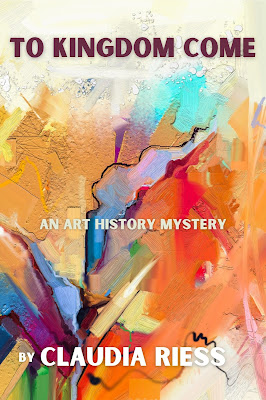
To Kingdom Come
An Art History Mystery
Series
Book 4
by Claudia Riess
~~~~~~~~~~~~~~~~~~~~~~~~~~~~~~~~~~~
GENRE: Mystery
~~~~~~~~~~~~~~~~~~~~~~~~~~~~~~~~~~~
BOOK BLURB:
Amateur sleuths, Erika Shawn-Wheatley, art magazine editor, and Harrison Wheatley, art history professor, attend a Zoom meeting of individuals from around the globe whose common goal is to expedite the return of African art looted during the colonial era. Olivia Chatham, a math instructor at London University, has just begun speaking about her recent find, a journal penned by her great-granduncle, Andrew Barrett, active member of the Royal Army Medical Service during England’s 1897 “punitive expedition” launched against the Kingdom of Benin.
Olivia is about to disclose what she hopes the sleuthing duo will bring to light, when the proceedings are disrupted by an unusual movement in one of the squares on the grid. Frozen disbelief erupts into a frenzy of calls for help as the group, including the victim, watch in horror the enactment of a murder videotaped in real time.
It will not be the only murder or act of brutality Erika and Harrison encounter in their two-pronged effort to hunt down the source of violence and unearth a cache of African treasures alluded to in Barrett’s journal.
Much of the action takes place in London, scene of the crimes and quest for redemption.
~~~~~~~~~~~~~~~~~~~~~~~~~~~~~~~~~~~
EXCERPT THREE:
He
wondered now why had it taken such an effort to decide which of his plans to
set in motion. Walking off with an artifact or two from Franks House, the
British Museum’s storage facility in East London, may have given him his
political statement, but at what cost? The place was crawling with workers in
lab coats and masks—conservators, project managers, photographers, interns,
auditors, volunteers—the lot of them engaged in the end goal of moving 200,000
objects from the museum’s collection of Africa, Oceania, and the Americans to
its nearly spanking new World Conservation and Exhibition Centre. True, it
would not have been an insurmountable task, entering the quiet road where the
quaint redbrick warehouse lay and unobtrusively blending into the workforce,
but then what? Would he have been forced to shoot his way out of the place at
the risk of being gunned down himself? How sordid and at the same time mundane
to mow down an uncalculated number of individuals, only to find himself a mere
casualty sprawled among them. Hell no, he was neither a loony terrorist nor a
crack- head martyr. The plan in place was the more sensible course, no question
about it.
It
was restful, hearing below his thoughts the rhythmic phrase of train wheels
clacking against the tracks in lulling repetition. His calmness surprised him a
little, given what lay ahead. His scenario had been well choreographed, but
only on an imagined stage with players moving about under his ironclad
direction. In real life, even the most meticulous plan is apt to be disrupted
by unforeseen circumstances. He knew that it was exactly 1.6 miles from
Effingham Junction Station to the mansion on Ockham Lane in Cobham, Surrey, but
was he certain that he would not be accosted by a madman or struck by lightning
on his walk to the place?
If he allowed his thoughts
to ramble on in this manner, his nerves would start acting up. He must lean
into the physical moment and move with it into his destiny. He looked out the
window past his reflection and focused on the indifferent stars.
~~~~~~~~~~~~~~~~~~~~~~~~~~~~~~~~~~~
GUEST POST:
The Craziest Thing I’ve Done in the Name of Research
Well,
maybe not the craziest, but surely one of the most embarrassing…
About
a year and half ago, I came across an intriguing reference to the Benin Bronzes
in a newspaper article. It sparked an
idea for an art history mystery. First
thing I did was order a copy of Stuart Butler’s Benin:
The Bradt Travel Guide.
When it arrived from Amazon two days later, I dug right in. I was reading some fascinating material on
Benin’s culture and had just embarked on the section entitled “Practical
Information,” when, on page 38, the following highlighted notice hit me like a
pie in the face:
BENIN AND THOSE BRONZES
I
don’t like to be the bearer of bad news, but if your chief reason for
visiting
Benin is to see the homeland of the famous Benin Bronzes then you
had
better cancel that ticket because you’ve got the wrong country.
I was humiliated, but not
defeated. After all, the notice itself
was an indication I was not alone in my ignorance and, as I discovered, like
misery, it loves company. Actually, this
flagrant proof of my ignorance had a positive effect on my motivation. I was more than ever determined to educate
myself on the subject, both for the sake of my potential mystery and, I would
like to think more so, as a matter of conscience. I read the reviews of books written on the
Kingdom of Benin (in modern-day Nigeria!) and, more specifically, on the
British “punitive expedition” of 1897, during which thousands of art and
artifacts were seized from Benin City, a few in retaliation for an aggressive
action that had occurred about a month earlier.
Dan Hicks’s The Brutish Museums: The
Benin Bronzes, Colonial Violence and Cultural Restitution,
appeared to be the most comprehensive coverage of the event and its surrounding
history. I started my education with the
Hicks book, and continued with John Warne Monroe’s Metropolitan Fetish: African Sculpture and the Imperial
French Invention of Primitive Art and Nigel Barley’s The Art of Benin. Only after completing an in-depth study of
the Benin Bronzes and related history did I feel confident enough to write the
opening sentence of a present-day murder mystery in which they play a pivotal
role: To Kingdom Come.
~~~~~~~~~~~~~~~~~~~~~~~~~~~~~~~~~~~
AUTHOR BIO:
Claudia Riess is an award-winning author
of seven novels, four of which form her art history mystery series published by
Level Best Books. She has worked in the
editorial departments of The New Yorker and Holt, Rinehart and Winston, and has
edited several art history monographs. Stolen Light, the first book in her
series, was chosen by Vassar’s Latin American history professor for
distribution to the college’s people-to-people trips to Cuba. To Kingdom
Come, the fourth and most recent, will be added to the syllabus
of a survey course on West and Central African Art at a prominent Midwest
university. Claudia has written a number
of articles for Mystery Readers Journal, Women’s National Book Association, and
Mystery Scene magazine. At present, she’s
consulting with her protagonists about a questionable plot twist in Chapter 9
of the duo’s murder investigation unfolding in book 5; working title: Dreaming of Monet, scheduled for release
winter 2024. For more about Riess and
her work, visit www.claudiariessbooks.com.
**This
post contains affiliate links and if clicked and a purchase is made, I may
receive a small commission to help support this blog. This does not cost you anything, it just
helps pay for all those fabulous community outreach projects and awesome
giveaways on here**
This contest is sponsored
by a third party. Fabulous and Brunette is a registered host of Goddess Fish
Promotions. Prizes are given away by the
sponsors and not Fabulous and Brunette. The featured author and Goddess Fish
Promotions are solely responsible for the giveaway prize.
Hey, lovelies!! It gives me great pleasure today to host Claudia
Riess and her new book, “Knight Light,” here on FAB!! For other stops on her Goddess Fish
Promotions Book Tour, please click on the banner above or any of the images in
this post.
Be sure to make it to the
end of this post to enter to win a $50 Amazon or Barnes and Noble Gift Card!!! Also, come back daily to interact with Claudia
and to increase your chances of winning!!
Thanks for stopping by!! Wishing you lots of luck in this fabulous
giveaway!!
Knight Light
by Claudia Riess
~~~~~~~~~~~~~~~~~~~~~~~~~~~~
GENRE: Mystery
~~~~~~~~~~~~~~~~~~~~~~~~~~~~
BLURB:
On
March 24, 1946, World Chess Champion, Alexander Alekhine, is found dead in his
hotel room in Estoril, Portugal. The
cause of death remains mired in controversy when, three-quarters of a century
later, a letter of his that could rock the art world is unearthed in a routine
home renovation in upstate New York. The
letter is addressed to a person of international repute and offers information
about art works looted during the German occupation of Paris.
When
the young man in possession of the letter is brutally murdered, his mentor, art
history professor Harrison Wheatley and Harrison’s sleuthing partner, art
magazine editor Erika Shawn, hurl themselves into the dual mission of tracking
down both the killer and the looted art.
The
hunt takes the couple to far flung locations, and as the stakes rise along with
the murder count, it looks like the denouement will take place far from the
comforts of home.
~~~~~~~~~~~~~~~~~~~~~~~~~~~~
EXCERPT TWO:
Mid-afternoon
Harrison was back from his lecture class on Baroque painting. He found Erika holed up in her third-floor
study, absorbed in whatever she was scribbling in her notepad. He pulled out the chair from what had once
been his grandmother’s vanity and sat beside her. Displayed on the computer screen was a series
of lines structured like a poem; at a glance, unintelligible. He planted a kiss on her cheek. “What the hell is it?”
She
put down her pen and turned to him.
“It’s a translated excerpt from Jean Arp’s poem ‘Der Vogel Selbdritt.’”
“That
explains why it’s inscrutable. It’s
Dada. Why is it of interest to you?”
“To
us,” she corrected. “I’ve been trying to
get a handle on our proposed investigation.
Let me start from the beginning.”
“Will
Lucas be joining us?”
“Not
for a while. He’s sleeping.”
“He
does a lot of that.”
She
smiled and flipped back the pages of her pad.
“First question: What’s the main
subject of interest—the MacGuffin, so to speak?
Answer: Alekhine’s letter.
Why? Because Alekhine died under
murky circumstances shortly after he wrote it.
Because it contains leads to recovering art lost during the war, which
is of great interest on all fronts honorable and evil. Because it’s the only document Chuck conveyed
to you, so he must have thought it was the most important one of the
collection. And last, because it’s the
only tangible item we’ve got.” She took
a breath.
“Next. Who would benefit from getting their hands on
this letter, either to gain information from it or to make sure the information
remains hidden? We have to exclude
anyone with honorable intentions, since violence was employed to secure the
document. The agency of evil comes from
the dark side of the art world. From
blackmail to black market.” She stared
hard at him.
“We
can voice our suspicions, but we cannot actually go there. You do understand, right?”
Harrison
nodded. “I do.”
“I’m
not convinced.”
“I
will never put you at risk.”
She
shook her head. “You left yourself out
of the equation. Not good enough.”
It
will have to be, sweetheart. “We will
both stay safe,” he said aloud. “Behind
the line of scrimmage. Go on with your
report.”
“Just
so you know, I don’t quite believe you.
But for now, let’s not lose our train of thought. So.
What are the lines of inquiry generated by Alekhine’s letter to
Ambassador Martins? One. Learn anything
we can about the fate of the Jules Eisenberg Gallery in Paris. This includes
its owners, their living relatives, if any, and its wartime art inventory. Two. Try to trace the provenance of the
paintings specified in the letter.
Three. Contact organizations that might help identify the German
referred to in the letter—the one who Alekhine says fled to Brazil.” She skewered him with another look. “The operative word here is identify. We identify.
The guys in bullet-proof vests track down.”
“Got
it.”
“Do
you?” She glanced down at her notes to
check if she’d missed anything. She
hadn’t.
“Anyway,
the hope is that down the road these lines of inquiry will intersect, and we’ll
be able to contribute a couple of leads to pass on to the authorities.”
“Who
are fixated on another line of reasoning altogether,” Harrison reminded her.
“We’ll
have enough evidence to convince them otherwise.”
“You’re
an optimist.”
“Realistic,
not wide-eyed.”
“And
it’s contagious,” he said, laying his hand on hers. “Now, tell me why you’ve got Jean Arp’s
poetry on display.”
~~~~~~~~~~~~~~~~~~~~~~~~~~~~
AUTHOR BIO:
Claudia Riess, a Vassar graduate who's
worked in the editorial departments of The New Yorker and Holt, Rinehart and
Winston. She is author of the Art
History Mystery Series published by Level Best Books and includes: “Stolen
Light,”* “False Light” and “Knight Light.” She is also author
of “Semblance of Guilt” and “Love and Other Hazards.”
“Knight
Light,” the third novel in her Art History Mystery Series, released
February 23, 2021, follows the series amateur sleuths Erika Shawn, art magazine
editor and Harrison Wheatley, art history professor, as they tackle the
sinister world of art crime that tests both their courage- and love-under-fire.
**This post contains
affiliate links and if clicked and a purchase is made, I may receive a small
commission to help support this blog.
This does not cost you anything, it just helps pay for all those awesome
giveaways on here**
This contest is sponsored
by a third party. Fabulous and Brunette is a registered host of Goddess Fish
Promotions. Prizes are given away by the
sponsors and not Fabulous and Brunette. The featured author and Goddess Fish
Promotions are solely responsible for the giveaway prize.
Hello, lovelies! It gives me great pleasure today to host Claudia
Riess and her new book, “False Light: An Art History Mystery”! For other stops on her Goddess Fish
Promotions Book Tour, please click on the banner above or any of the images in
this post.
Be sure to make it to the
end of this post to enter to win a $50 Amazon or Barnes and Noble Gift Card!!! Also, come back daily to interact with Claudia
and to increase your chances of winning!
This eBook is on SALE
during the book tour for ONLY $0.99!!!
See below for more details.
Thanks for stopping
by! Wishing you lots of luck in this
fabulous giveaway!
False Light: An Art History Mystery
by Claudia Riess
~~~~~~~~~~~~~~~~~~~~~~~~~~~~~~~~~~
GENRE: Mystery
~~~~~~~~~~~~~~~~~~~~~~~~~~~~~~~~~~
BLURB:
Academic
sleuths Erika Shawn, art magazine editor, and Harrison Wheatley, a more
seasoned art history professor, set out to tackle a brain teaser. This time the couple—married since their
encounter in Stolen Light, first in the series—attempt to crack the long
un-deciphered code of art forger Eric Hebborn (1934-1996), which promises to
reveal the whereabouts of a number of his brilliant Old Master
counterfeits. (Hebborn, in real life,
was a mischievous sort, who had a fascination with letters and a love-hate
relationship with art authenticators. I
felt compelled to devise a puzzler on his behalf!) After publication of his memoir, Drawn to
Trouble, published in 1991, he encrypts two copies with clues to the treasure
hunt. On each of the title pages, he
pens a tantalizing explanatory letter.
One copy he sends to an art expert; the second, he releases into general
circulation. The catch: both books are
needed to decipher the code.
When
the books are at last united 25 years later, Erik and Harrison are enlisted to
help unearth their hidden messages. But
when several research aides are brutally murdered, the academic challenge leads
to far darker mysteries in the clandestine world of art crime. As the couple navigate this sinister world,
both their courage under fire and the stability of their relationship are
tested.
~~~~~~~~~~~~~~~~~~~~~~~~~~~~~~~~~~
EXCERPT TWO:
Erika
would not permit herself to sleep. She gave in to her selfish body only to
allow it to lean its skull and spine against the wall as she went over, again
and again, the day’s nightmare. Reliving it kept the memory raw; healing,
impossible.
There
was a light tapping on the door. She didn’t know how long she had been sitting
there, only that the scant light in the room had dimmed. There was another tap.
“Miss
Erika? May I come in?”
It
was Grace. Erika had never heard the woman’s supplicating tone of voice, but
who else could it be? “Grace?”
“Yes,
Miss. Please, may I?”
A
kind of dull curiosity moved her to answer, “Come in.”
Grace
opened the door and entered the room. She was holding a tray, bracing one side
of it with her forearm. She turned the knob with her free hand and shut the
door, then better secured the tray. “I’ve brought you some cream of tomato soup
and a muffin. You need some nourishment. Would you turn on the light? You
wouldn’t want this old lady to trip, would you?”
Grace’s
gentle prodding was so uncharacteristic that it caused Erika to rise to her
feet and obey, as if to the command of a hypnotist. She clicked on the wall
light and took the tray from Grace.
“Where
should I put it?”
Grace
scurried to the vanity table and pushed aside Erika’s pads and pens. “Right
here is good.”
Erika
did as she was told. Grace pulled out the chair from the vanity and reached up
to touch Erika’s shoulder. “Now sit and have some soup.” She smoothed her
scalloped white apron overlaying her starched black dress and stood there,
waiting.
“I’m
not hungry, Grace.”
“You
don’t want to be hungry, but you are,” Grace said, without budging.
There
seemed to be no choice but to heed Grace’s first prompt. Erika sat down. She
had no intention of lifting the spoon provided. “Thank you.” She waited for
Grace to exit the room.
Grace
wasn’t going anywhere. She strode to the desk and dragged the desk chair to the
vanity, placing it directly alongside Erika’s chair. She sat down. “You must
take care of yourself—for yourself as well as your husband,” she said. “He
loves you so. I have never seen him so distraught.”
“Harrison
will be fine,” Erika said, staring straight ahead.
Grace
shook her head. “Not if you aren’t.” She took Erika’s hand in her own. “I
haven’t been very cordial to you. I apologize.”
“Apology
accepted,” Erika said, feeling nothing.
“I
have no children,” Grace said. “I worked for Harrison’s grandparents for fifty
years. I’ve known Harrison all his life, and he is family to me; my only
family. He is a dear man, but terribly naïve. It broke my heart to see his
first wife take advantage of him. She nearly destroyed him. I was afraid you
might do the same.”
“I
won’t.” She withdrew her hand from Grace’s.
“I
know you won’t. I see how you are with him. I see how you look at him.
My
prejudice made me blind to this, but now I see.”
Erika
turned to Grace. “I’m empty, Grace. Do you see that?” She returned her focus to
the wall.
~~~~~~~~~~~~~~~~~~~~~~~~~~~~~~~~~~
BOOK TRAILER:
~~~~~~~~~~~~~~~~~~~~~~~~~~~~~~~~~~
GUEST POST:
Exploring
the conflict of self-determination and the yielding of self has always been of
great interest to me. Staunch
independence vis-à-vis romantic love, which is submissive either by nature or
indoctrination, seems to be a philosophical and evolutionary subject to grapple
with. I deal with the issue head-on by
putting characters in situations where they’re struggling to define themselves
at the nexus of this conflict. For a
chronically hopeless romantic myself, the experience can prove to be both daunting
and self-enlightening.
For
starters, I find it helps to differentiate between the characterizations of
“tough” and “strong.” Granted, both
words can be nuanced to the point of no return, so I like to keep it simple. I
think of “tough,” in the context of behavior, as tough as nails, tough as
leather, impervious, non-resilient, averse to change. Of course, toughness can on occasion be a
handy asset. A warrior is tough; she cannot be dissuaded from her mission. This
is a good thing, especially when the merest distraction can bring destruction
to the individual or planet she is committed to save. However, when it comes to tenaciously
adhering to questionable or self-defeating views or behaviors, not so good. The latter can be a more complex situation
for an author and her characters to deal with, so I find it’s helpful to stick
to the simple connation of “tough.” On
the other hand, I think of a “strong” character as resilient without being
gelatinous, vulnerable without being a pushover.
Sometimes
tough passes for strong. Case in point:
Erika Shawn, co-protagonist in my art history mystery series. She’s ever-evolving; tested from forces
within and without. She starts out in
the first book, Stolen Light, firmly entrenched in the idea that by
nature, men’s protestations of loyalty cannot be trusted. Her father, with whom
she’d had what she thought was an unassailable relationship, had walked out on
her and her mother at a critical point in their lives, just when he was needed
most. Subsequent relationships only
served to confirm her view. She’s
steeled herself, does not allow the notion of love to hamper her pragmatic sex
life. She’s smart, sassy, can out-repartee
anyone up for the challenge. She appears
to be strong, but is she? By being
risk-averse, her emotional life remains stunted; in permanent quarantine. Only when Harrison Wheatley comes into the
picture is her stultifying creed tested.
The first hint of it comes early on in the book, when they’re driving
out to eastern Long Island, en route to their first sleuthing venture:
“Their
splayed hands were inches apart on the leather seat. It would have been so
easy, so sweet, to slide her hand into contact with his. Yet under these
circumstances, with her gauzy feeling threatening to overcome her good sense,
no. There would be no romance: Sleeping Beauty segueing from coma to dream
world, never truly waking up. She knew
from experience that the real ending of the story was disappointment, energy
wasted.”
Letting
her guard down and opening herself to a fuller life, albeit with its inherent
risks, would be difficult for Erika, and maybe never totally realized. In Stolen Light, as well as in the
books to follow—False Light and Knight Light (in the works)—she
faces other dangers, circumstantial as well as internal. She struggles with the emotional trauma of a
miscarriage and the repercussions to her sense of self-worth. She resists Harrison’s over-protectiveness. Her courage is tested when she’s thrown into
life-threatening situations. She grows; becomes more resilient. She can take risks without the fear of
forfeiting self-governance. In the end,
when it comes to matters of the heart, she is able to bridge the gap—not
without an occasional relapse—between staunch independence and romantic love.
A tough character devoid of
human frailty is more of an emblem than a person a reader can relate to. When invested in characters, I try to go with
the flow, not analyze them, at least not while they’re in transit. After a scene or a chapter, maybe, but not
when my neck’s pulsing with theirs. It may be helpful to make use of words like
“tough” and “strong,” but to solidify guidelines into hard and fast rules
would, like overbearing parents, hinder the growth of characters out on their own
for the first time. By the same token, I
try not to over-analyze the likes or expectations of the reader. If I can empathize with the characters, I
figure there’s a good chance the reader will.
~~~~~~~~~~~~~~~~~~~~~~~~~~~~~~~~~~
AUTHOR BIO:
Claudia Riess, a Vassar graduate, has
worked in the editorial departments of The New Yorker and Holt, Rinehart, and
Winston and has edited several art history monographs.
**This post contains affiliate links and if clicked and a
purchase is made, I may receive a small commission to help support this
blog. This does not cost you anything,
it just helps pay for all those awesome giveaways on here.**
This contest is sponsored
by a third party. Fabulous and Brunette is a registered host of Goddess Fish
Promotions. Prizes are given away by the
sponsors and not Fabulous and Brunette. The featured author and Goddess Fish
Promotions are solely responsible for the giveaway prize.